
Most Problems
Aren’t The Problem
Many people solve the problem they can see.
Operators solve the one causing it.
Learn to Walk Upstream
A lot of people think operational thinkers are the "fixers" and fixers are the people with all the answers.
They're not.
The best fixers are the people who can see the system, while most people can only see the problem.
"Sales are down."
"The project is behind."
"The website isn't generating leads."
"Employees are frustrated."
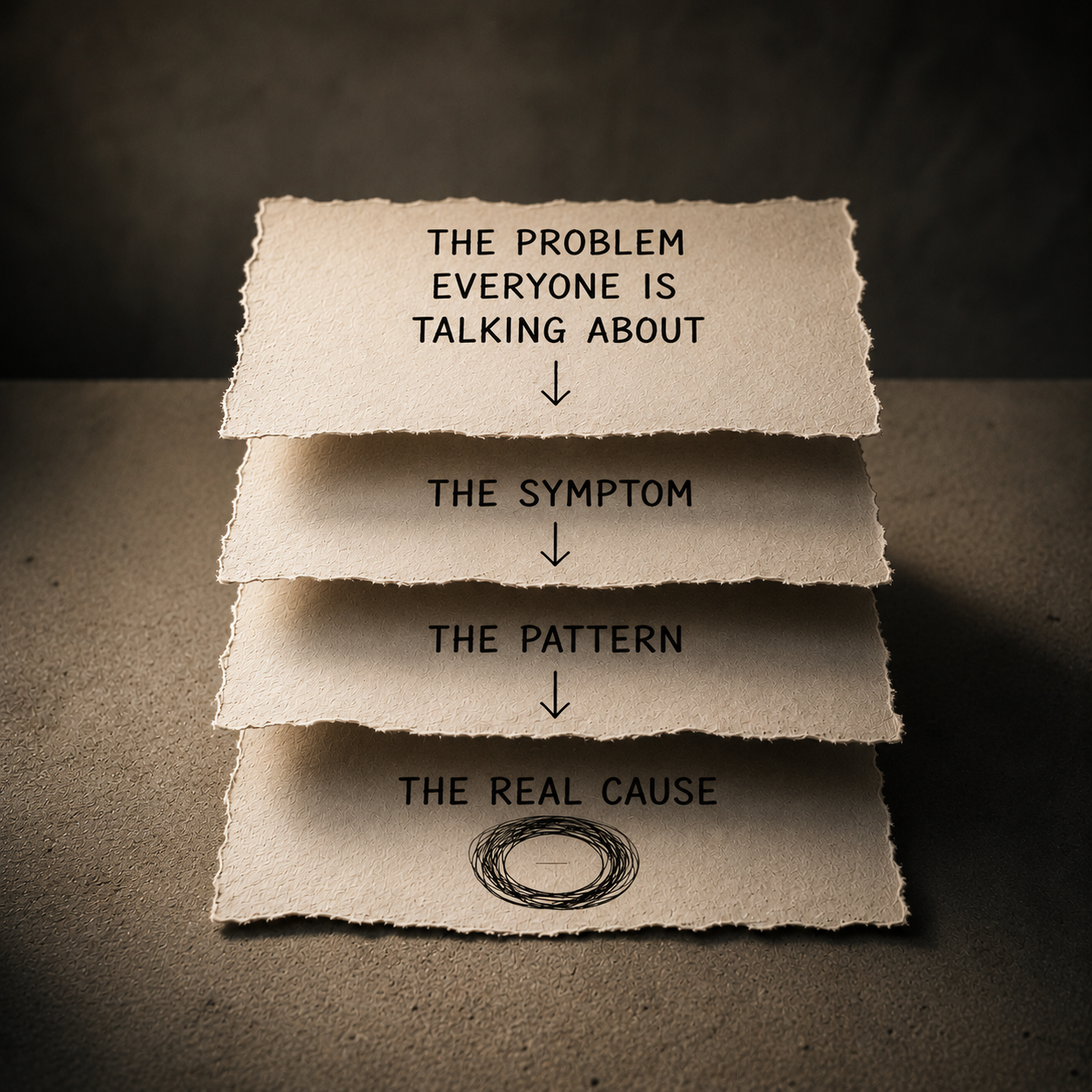
An operational thinker sees something different. They see a chain of causes.
Sales are down because leads are down.
Leads are down because traffic is down.
Traffic is down because nobody knows the company exists.
Nobody knows the company exists because there is no content strategy.
There is no content strategy because nobody owns marketing.
The real skill is tracing symptoms backward until you find the leverage point.
It's doing the walk upstream.
To become better at operational thinking, practice walking upstream.
So, how do we change the mindset? How do we train ourselves to think more strategically and operationally?
Most People See Problems. Operators See Patterns.
I often find myself asking how I can become better at solving the problems that seem to take up so much of our time and energy. Not because I want to be better than anyone else, but because I've realized many of us are struggling with the same underlying challenges. They just show up in different forms.
My mind naturally gravitates toward the root cause. I'm rarely satisfied with asking, "How do I fix this?" Instead, I find myself asking, "How do I make this better and solve this permanently?"
More importantly, how do I create a solution that helps others as well, so they can spend less time fighting recurring problems and more time focused on what truly matters in their world?
The most meaningful solutions aren't the ones that put out today's fire. They're the ones that remove the need to fight the same fire tomorrow. Freeing people to focus on the work, goals, and relationships that matter most.
So, I started asking myself: "Can operational and strategic thinking be learned? Can you train yourself to become better at solving bigger, more complicated problems?"
I think you can.
And if you've ever thought, "I'm pretty good at thinking strategically, but how do I become even better?" You might already be closer than you realize.

Start By Asking Better Questions
Whenever someone presents a problem, force yourself to look at the bigger picture. Ask questions at a different level, from a different angle, or a different role within the process.
Here's an example: A founder says, "We need a new website."
Maybe you do. Maybe you're not seeing the bigger picture. Why do we need a new website?
Maybe the founder is trying to drum up business and is thinking a redesigned and refreshed website is the solution.
As an operational thinker, ask yourself:
1. Is this the problem or a symptom?
Do we need a new website? Or do we need more leads, clearer messaging, faster response times, or a better sales process?
Will the website solve the problem and, if so, is it a permanent solution or just a temporary bandage?
Organizations spend thousands of dollars fixing symptoms every day only to find the problem still exists. Maybe it's changed and is presenting itself in a different way, but ultimately, it's still there.
2. What happened before this?
This is one of the most powerful operational questions you can ask. If a customer is unhappy…
What happened immediately before that?
Then before that?
Then before that?
Keep walking upstream and you'll find most permanent fixes are found there.
3. Who owns this?
Operational problems often survive because nobody owns them.
Every recurring issue should have:
An owner
A process
An expected outcome
If one of those is missing, that's usually where the problem lives.

Learn to See Systems Instead of Tasks
Most people operate at the task level.
Operational thinkers operate at the system level.
Task thinker: "I need to answer these emails."
System thinker: "Why do these emails keep happening?"
Task thinker: "I need to schedule another meeting."
System thinker: "Why does this require a meeting at all?"
Task thinker: "I need to update this spreadsheet."
System thinker: "Why isn't this automated?"
One of the biggest leaps in strategic thinking happens when you stop asking:
"How do I do this?"
and start asking:
"Why does this exist?"

Document Patterns
For me, this is where a lot of my own strengths show up.
Whether it's a SharePoint environment, an operational framework, a pricing model, a workflow, or a governance structure, it all comes back to pattern recognition.
Every time I solve a problem, I ask myself: "Is this a permanent solution or a temporary Band-Aid?"
If it's permanent, I document it.
If it's temporary, I keep digging.
The people who become indispensable to an organization aren't solving the same problem fifty times. They're building systems so nobody has to solve it again.
Learn to Read a Business Like a System
When you encounter a company, department, nonprofit, side hustle, or project, mentally dissect it.
Ask yourself:
How does money enter?
How does money leave?
How does work enter?
How does work leave?
Where are the bottlenecks?
What breaks if one person disappears?
What process is being held together by hope and duct tape?
You can do this anywhere: restaurants, schools, churches, government offices, websites, anything. The more systems you mentally reverse-engineer, the faster you become at diagnosing new ones.
Stop Chasing Solutions
This may be the hardest lesson of all. New fixers want solutions. Experienced operators want understanding.
The first instinct shouldn't be: "Here's what we should do."
It should be: "Help me understand what's actually happening."
I've watched people spend months solving the wrong problem because they fell in love with a solution before they understood the system.
How to Practice Without Clients
The good news is that you don't need clients to develop operational thinking. You need systems, and systems are everywhere.
Pick a business and reverse-engineer it.
Audit a website and identify the operational problems hiding behind the marketing.
Read customer complaints and diagnose the process failures underneath them.
Play the "5 Whys" game with anything frustrating in your own life.
Become obsessed with bottlenecks.
Ask yourself one simple question everywhere you go: What's slowing this down?
Not what's wrong.
What's slowing it down?
Those are very different questions.
The pattern you'll eventually see is that many of us have already been doing this for years without realizing it. If you've ever saved your company money by reviewing a vendor contract, streamlined a process, rebuilt a website, rolled out a major project, or created a governance structure, you've already been operating this way.
Operators see connections. They see cause and effect. They see how decisions ripple through a system.
If you want to get better at being a fixer, spend less time looking for answers and more time learning to identify the real problem.
The problem hiding underneath the one everyone is talking about.
That's where operational thinking starts.