
6 Lessons
Small Business
can learn from
Big Business
Lessons Learned by the Big Companies so Small Business Don’t Have to.
Small business owners are often told to “think bigger”. but I don’t always agree.
Bigger is not automatically better. Bigger can be slower, louder, more complicated, more political, more expensive and buried more in meetings than actual movement.
After spending more than twenty years inside large organizations and running three small businesses over the years, I can honestly say large companies are not successful because they have everything figured out.
Because trust me... they don’t.
They lose information, duplicate work, and overcomplicate decisions. They buy software nobody uses and hold meetings that could have been emails while sending emails that should have been conversations.
So no, the lesson for small businesses is not to become more corporate.
The best small businesses have something large companies spend millions trying to recreate: speed, closeness to the customer, common sense, personal ownership, and the ability to adjust quickly.
Large companies do, however, learn certain lessons the hard way, and they learn them because complexity gives them no choice.
At a certain size, you cannot run the business from memory anymore. You cannot rely on one person knowing where everything is or assume everyone heard the same thing in the meeting. You cannot make every decision in the owner’s head or let every process live in someone’s inbox, notebook, or in an “I just know how we do it” system.
Eventually, the business becomes too big for heroics, and that’s exactly where small businesses can learn something valuable. Not bureaucracy or red tape, and definitely not more meetings for the sake of meetings.
The real lesson is: A business becomes stronger when important things stop depending on one person remembering them.
Big Companies Are Forced to Build What Small Businesses Can Choose to Build
In the early days of a small business, informality feels like a strength. The owner knows the customers, the team is small, everyone talks to everyone, and problems get solved quickly because the same few people are close to everything.
That closeness is powerful, but as the business grows, the same habits that once made it flexible can start making it fragile.
The owner becomes the answer key.
The longest-tenured employee becomes the process manual.
The inbox becomes the filing system.
The group text becomes the project tracker.
The customer experience depends on who happened to answer the phone.
Yikes.
The business may still be moving, but underneath it, too much is being held together by memory.
Large companies cannot survive that way for long because they have too many people, customers, vendors, locations, risks, and moving parts to pretend memory is a system.
So, they create structure. I’ll be honest, some of it is excessive. Some of it is clunky. And some of it deserves every eye roll it gets. But buried inside all that corporate structure are a few very useful principles small businesses can borrow without becoming stiff, cold, or overcomplicated.
Lesson 1: Stop Building the Business Around People
This one is uncomfortable because small businesses are personal. They’re often built around trust, loyalty, relationships, instinct, and people who care deeply.
This is, honestly, beautiful. Unfortunately, it’s also very risky.
If one person leaving, getting sick, taking vacation, or becoming overwhelmed can cause the whole operation to wobble, the business is not running on a process, it’s running on a person.
Large companies learn this constantly. People change roles. Vendors change. Leaders leave. Teams reorganize. If everything depends on one person’s memory, the business pays for it every time there is turnover.
Small businesses feel this too, but they often explain it differently.
They say:
“She’s the only one who knows how to do that.”
“I just keep all that in my head.”
Or my personal favorite: “We’ve always done it this way.”
Those sentences sound normal, but they are actually warning signs.
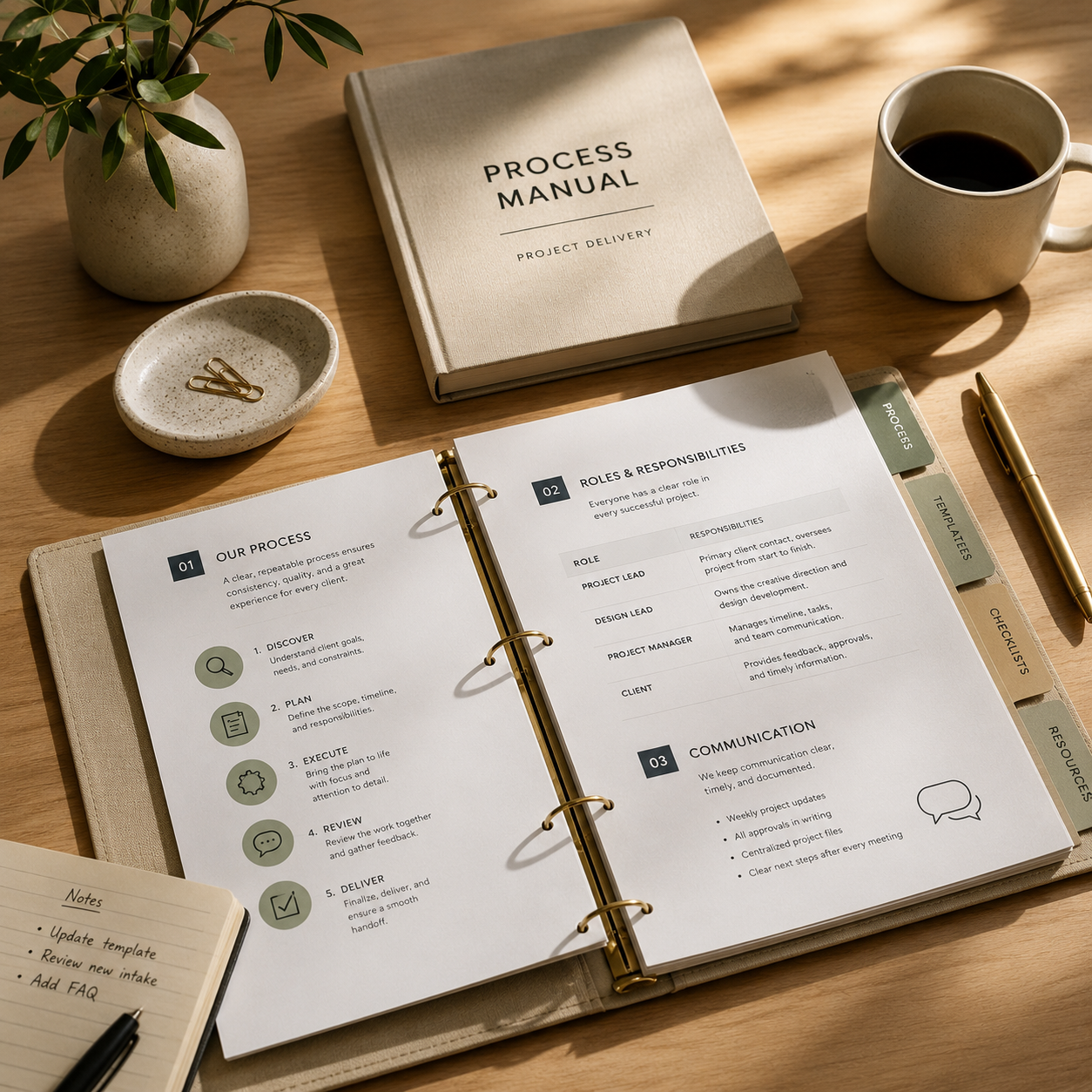
Now, before you strangle me, I’m not saying every task should be documented in painful detail. That’s not the point. The point is to identify the work that creates real risk if it lives with only one person: customer onboarding, password access, vendor contacts, renewal dates, accounting processes, project handoffs, website updates, file locations, and refund policies. Basically, how work moves from the initial request to final completion.
Those things need a home because people deserve support.
A documented process is not a lack of trust. It’s a safety net. It protects the business, but it also protects the people within it from carrying too much alone.
Lesson 2: Decisions Need a Place to Land
One of the biggest differences between small and large organizations is not how many decisions they make, it’s what happens after the decision is made.
In a small business, a decision is often made in conversation. A quick call, hallway chat, text message, or a meeting where everyone nods.
Then two weeks later, someone asks: “Wait, did we decide to do that?”, or “I thought we were waiting.” or “I didn’t know that changed.”
The problem is not that people are careless, it’s just that the decision never landed anywhere.
Large organizations are not perfect at this either, but the better ones understand something important: decisions create work. Work needs ownership. Ownership needs clarity. A decision that is not captured becomes a rumor. A decision without an owner becomes a wish. A decision without a next step becomes a meeting memory.
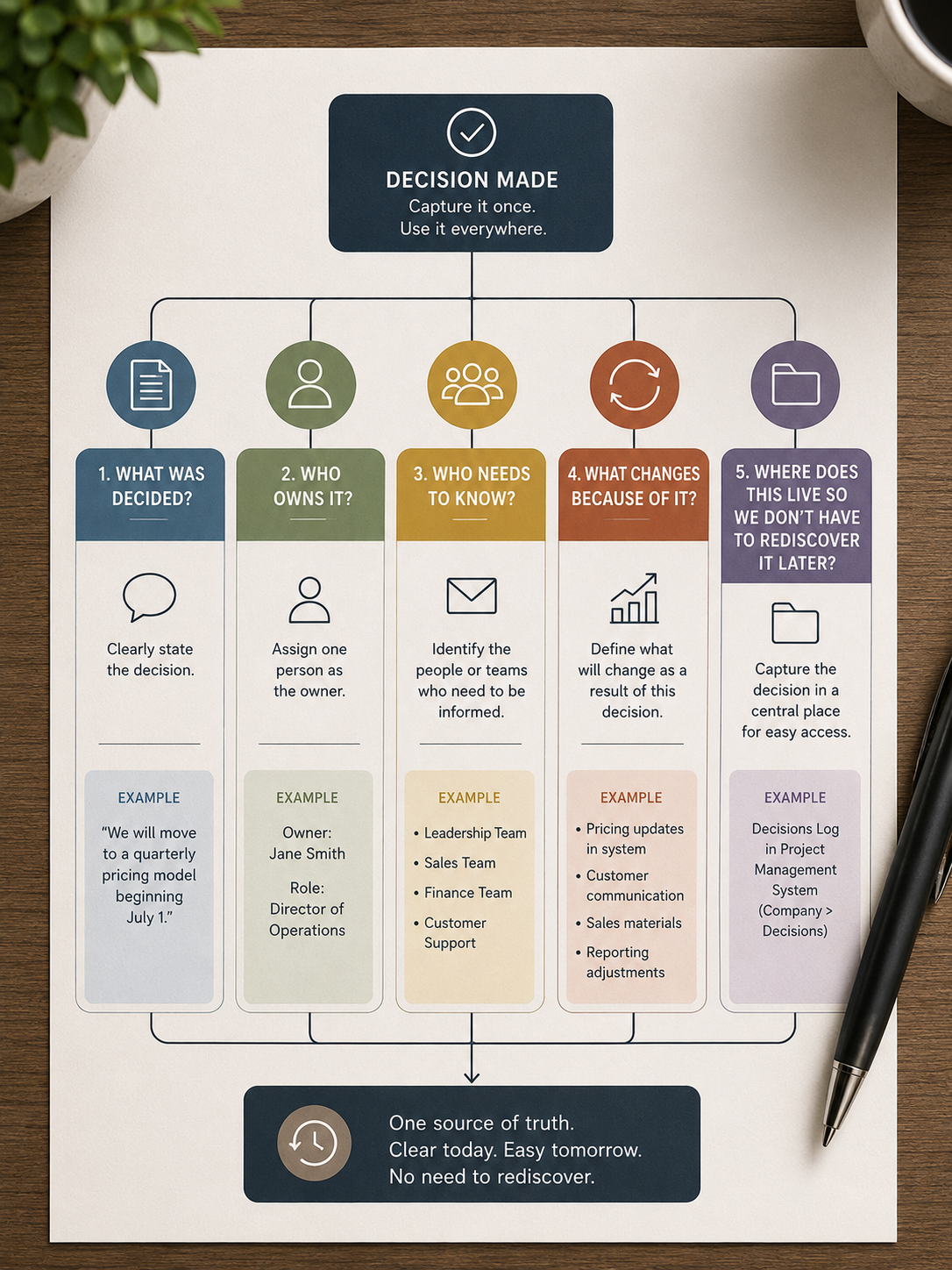
Small businesses do not need complicated governance models to fix this. They just need simple decision discipline. With just five questions, a small business can document a decision and communicate it out to the team.
What was decided?
Who owns it?
Who needs to know?
What changes because of it?
Where does this live so we don’t have to rediscover it later?
That one small habit and five simple questions can literally change everything.
It reduces rework, prevents confusion, and stops the business from having the same conversation seven different times.
Having been there, I can tell you from experience, repeating the same conversation over and over makes a root canal sound appealing. Maybe most importantly, it helps the owner let go without losing control.
Control does not always come from being in the weeds on everything. Sometimes control comes from creating enough clarity that other people can move without constantly coming back to you.
Lesson 3: Communication Is Infrastructure
Most businesses treat communication like a personality trait. Some people are “good communicators,” and some are not, but in a functioning organization, communication cannot depend entirely on personality. It must be designed.
Large companies learn this because poor communication is expensive. Projects fail because the wrong people were left out. Customers get frustrated because expectations were unclear. Teams duplicate effort because nobody knew someone else was already working on it. Leaders make decisions with partial information because updates never reached them.
Small businesses experience the same problems, just in smaller rooms. A customer who thought something was included. A team member who didn’t know the deadline changed. A project that stalls because the next step was obvious to one person and invisible to everyone else.
That is not a people problem.
It is a communication problem.
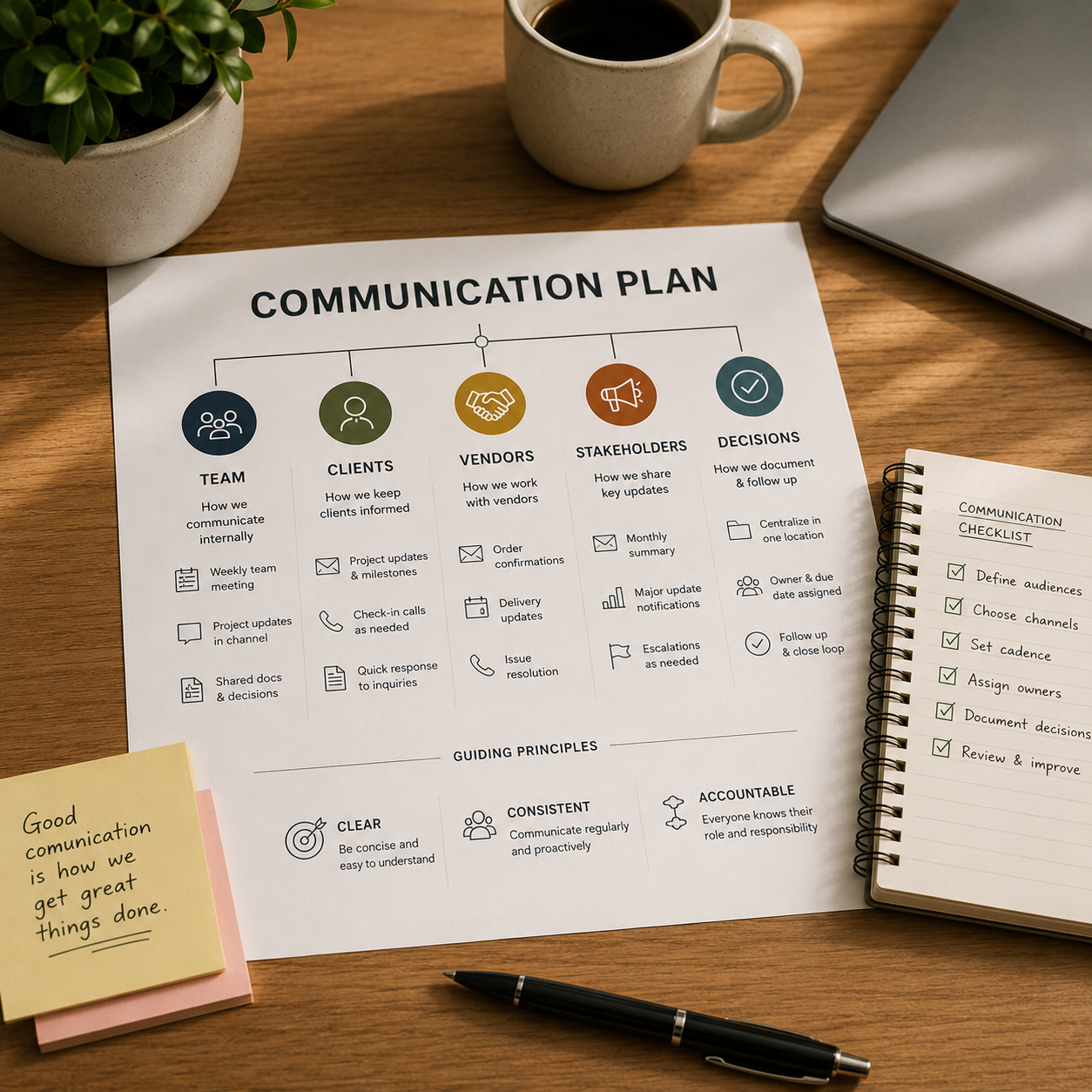
A communication system does not have to be fancy. It simply answers questions like:
· Where do project updates go?
· How do we know what is waiting on someone else?
· When something changes, who needs to be told?
· What information belongs in email, what belongs in a project tool, and what needs a conversation?
· How do we prevent important details from disappearing into texts, inboxes, or memory?
The goal is not more communication, it's better movement of information. The RIGHT information, in the RIGHT place, at the RIGHT time, for the RIGHT people.
That is not corporate fluff, it's operational oxygen.
Lesson 4: Growth Does Not Remove Chaos. It Magnifies It.
A lot of business owners believe growth will make things easier. With more customers, more revenue, and more help, we’ll have more room to breathe.
Sometimes that happens, but far too often, growth does something else first. It exposes what was already weak. The scheduling process that worked with ten customers starts breaking at fifty. The file structure that made sense to one person becomes a maze for five other people. Customer experiences that once felt personal become inconsistent. The owner who wanted freedom becomes the person everyone waits on.
One of the biggest lessons small businesses can learn from companies much larger is growth increases the cost of disorder.
A small inefficiency repeated ten times is annoying, but repeated a thousand times is expensive. Unclear handoffs between two people are frustrating, but across departments, vendors, locations, or customers, they become structural problems.
That does not mean small businesses should invest in enterprise-level systems before they need them. It simply means they should pay attention to repeated friction.
Repeated friction is a signal.
If the same question keeps coming up, something needs to be clarified.
If the same mistake keeps happening, something needs to be redesigned.
If the same person keeps becoming the bottleneck, something needs to be redistributed.
The problem is not always the people. Many times, the system is simply asking people to compensate for something that should have been made clearer.

Lesson 5: Technology Works Best After the Process Makes Sense
Large companies spend enormous amounts of money on technology. Some of it helps, but some of it creates a very expensive version of the same old mess.
This is another lesson small businesses should take seriously. Software does not fix confusion. It usually speeds it up.
If nobody agrees on the process, the tool becomes a battleground. If nobody knows who owns the work, the software becomes a place where tasks go to be ignored. If files are already disorganized, moving them into a new platform does not magically create order.
In other words: garbage in, garbage out.
Small businesses are constantly sold tools as if the tool itself is the transformation.
"Get this CRM."
"Get that project management software."
"You need this AI tool."
"You just need automation."
"... And don’t forget the client portal!"
Will those things help? Maybe. But only if the business first understands what it is trying to improve.
What is the work?
Where does it start?
Where does it get stuck?
Who touches it?
What information is needed?
What should the customer experience feel like?
What should become easier after the technology is added?
Large organizations often learn this through painful, expensive implementations. Small businesses have the advantage of learning it earlier and cheaper.
The best technology does not make a messy business look modern. It makes a clear business easier to run.

Lesson 6: Risk Management Is Not Just for Big Companies
When people hear “risk management,” they often picture corporate committees, legal departments, cybersecurity policies, or binders nobody wants to read.
I’ll let you in on a secret: Risk management is much simpler than that.
Risk management simply means asking:
What could hurt the business?
What are we depending on?
What do we need to protect?
What would happen if this person, tool, vendor, file, account, or process was suddenly gone?
Large organizations ask these questions because they have to. Small businesses should ask them because the impact can be even more personal and, in some cases, catastrophic.
A lost password can stop work. A hacked account can damage trust. A missing contract can create confusion. A single laptop can hold years of business history. A key employee can carry knowledge nobody else has.
This is not fear-based thinking. It’s responsible ownership.
Small businesses do not need massive policy manuals to start reducing risk.
They need a few practical habits:
· Keep critical information somewhere secure and findable.
· Know who has access to what.
· Document the things that would be painful to recreate.
· Create basic backup plans.
· Make sure important business accounts are not tied to only one person’s memory, phone, or inbox.
That is not bureaucracy. That is business continuity planning in plain English.

The Real Lesson: Big Companies Build Guardrails Because Complexity Punishes Guesswork
The most valuable thing small businesses can learn from large companies is not how to become more corporate. It’s how to become less fragile.
Large organizations are forced to create guardrails because complexity punishes guesswork. Small businesses can create guardrails earlier, before the pain becomes expensive.
But not too many guardrails. You have to be realistic. Add too many, or the wrong ones, and you’ll quickly slow everyone down. You need just enough structure to make the business easier to understand, operate, and grow.
A good system does not trap people. It frees them from constantly reinventing the same decisions. A good process does not remove judgment, it gives judgment a clearer place to operate. The same goes for documentation. It does not make a business less human, it protects the humans from carrying every detail in their heads.
That is the real lesson.
It’s not about making a small business feel big. The goal is to give a small business the kind of clarity that allows it to stay personal, responsive, and thoughtful without depending on exhaustion behind the scenes.
The best businesses are not held together by heroics forever. Eventually, they are held together by clarity.
And clarity is something small businesses can start building long before they become big.